
Nearly every corporate event hits this decision. The venue has an in-house audio visual provider, bringing in anyone else usually carries a fee, and the planner has to decide whether the convenience is worth it. There is a real answer, and it depends on the event rather than on principle.
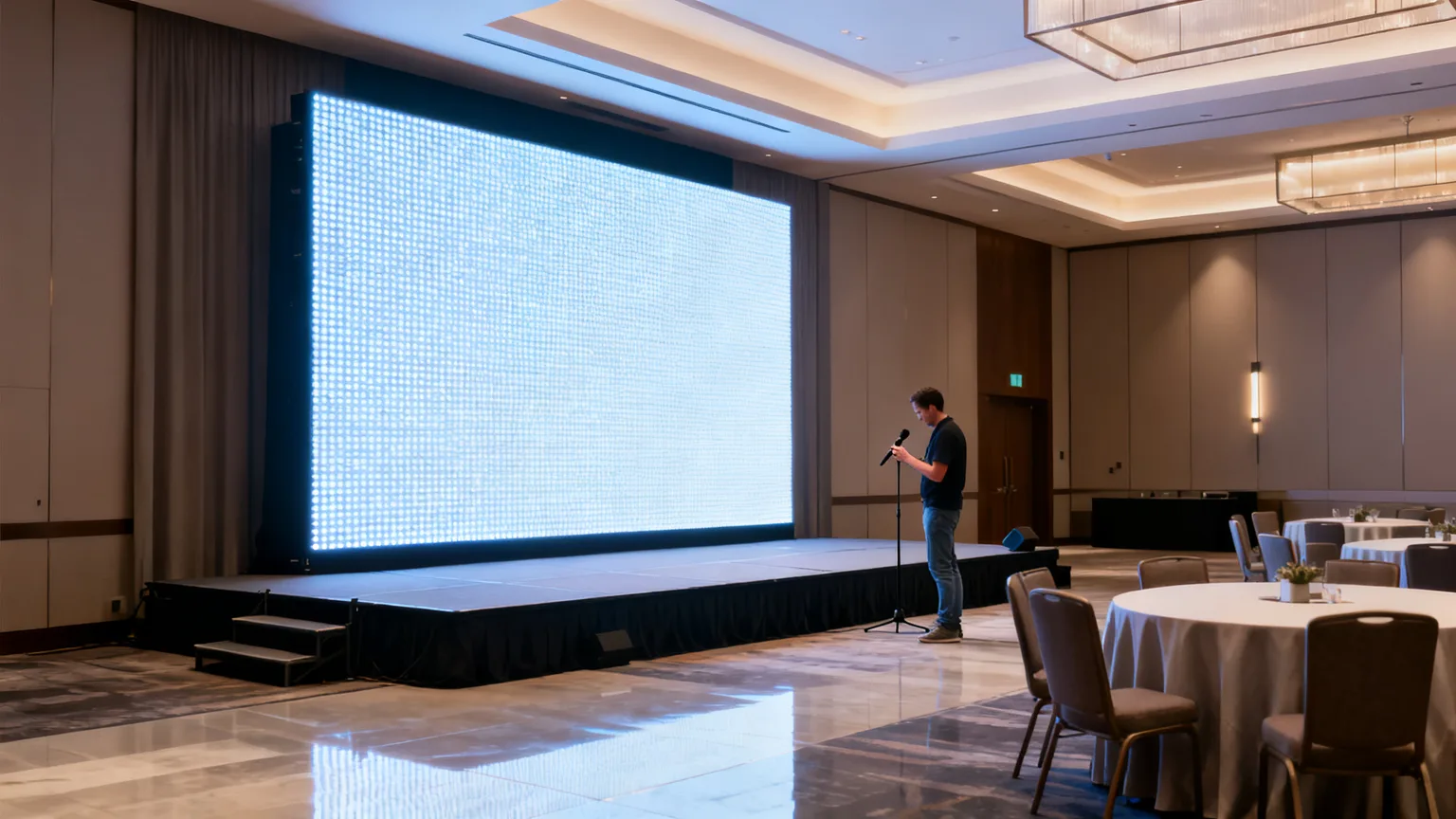
In-house AV is genuinely the right choice more often than outside vendors admit. They know the building. They know where the power is, how the loading dock works, which ballroom has the low ceiling and which has the structural column nobody drew on the floor plan. For a straightforward meeting in a room they set up every week, that familiarity is worth a great deal and the convenience is real.
It gets harder to justify as the room gets bigger. In-house inventory is specified for the venue's typical event, which is usually a mid size meeting. Once you are into general session scale, LED walls, multi camera recording or anything with a creative look to it, you are often renting the venue's subcontracted equipment anyway, with a margin on top and less control over what turns up.
The real question is who owns the outcome. In-house AV works for the venue. That is not a criticism, it is the job. If your event needs someone whose only priority is your show, whose reputation rides on it, and who will push back on a venue decision that hurts the production, that is a different relationship.
Visibility changes the calculation. An internal team meeting that goes slightly wrong is a story people forget by Friday. A shareholder meeting, an awards gala, a product launch or anything being recorded and reused afterwards does not have that luxury. The more external eyes, the more the production should be owned by someone accountable to you.
Outside AV goes badly when the production company does not know the building. This is the legitimate concern venues have, and it is why fees exist. A crew that has never been in the room runs long on load-in, improvises power, and ends up leaning on the venue's staff. Any outside company worth hiring will walk the space in advance and work to the venue's rules rather than around them.
How to get the best of both. Tell the venue early that you are bringing in production, name the company, and have them walk the room before contracting. Most venues are entirely reasonable about outside AV when they are told in advance by a crew that behaves professionally. The friction almost always comes from surprise rather than from policy.
A practical test. If you can describe your event as 'a presentation in a room', in-house is probably fine. If it involves a built stage, LED or large format screens, recording or streaming, multiple simultaneous rooms, or anything a senior executive will stand in front of, you want a production partner.
What to ask either way. Who is the technician on site and are they there for the whole event? What is included for redundancy? Is there a confidence monitor? How many wireless channels? Those four questions are more revealing than the total at the bottom, whoever is answering them.
We work in hotels and conference centres across Texas and we would rather walk a building before we are hired than after. If you are weighing this for an upcoming event, tell us the venue and the date and we will give you a straight read, including when in-house is the better answer.